Current Research Projects
Differential expression of genes and apoptosis is the theme of our ongoing research
Survival signals induced by cholesterol oxidation by-products in atherosclerosis:
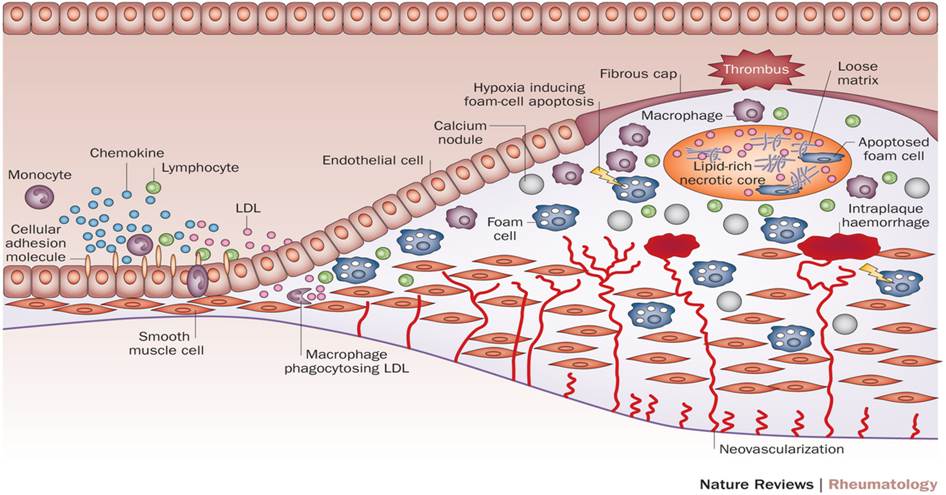
Our research focus is the role of reactive oxygen species (ROS), particularly cholesterol oxidation products and their signaling cascades, important in vascular remodeling. In this relation, we are currently studying the effects of oxysterols on cell survival and apoptosis pathways in atherosclerotic vascular remodeling. In order to identify the main genes and related products involved in the transduction of survival signals and elucidate the relevant molecular mechanisms in human macrophagic cells (U937) challenged with 27-hydroxycholesterol in the low micromolar range, we study MAPK activities and Bcl-2 family protein levels. Results will be useful to enhance our knowledge on the modulation of these pathways and to suggest preventative strategies to treat oxidative stress-related conditions. We collaborate with Prof. Giuseppe Poli, University of Turin, Italy.
Â
   Formation of atherosclerotic plaque (click to enlarge)
  miRNAs in determining drug sensitivity/resistance:
 Resistance of cancer cells to chemotherapy continues to be a major clinical obstacle to the successful treatment of cancer.  Currently, extensive studies have indicated the existence and importance of nonmutational regulation of gene function mediated by means of short noncoding RNA, microRNAs (miRNAs). Aberrant levels of miRNA have been reported in a variety of human cancers. They have been shown to have both diagnostic and prognostic significance and to constitute a novel target for cancer treatment. Recently, the evidence of the roles for microRNAs in determining drug sensitivity/resistance has been emerging and accumulating evidence is revealing that miRNA expression profiling can be correlated with the development of anticancer drug resistance. Our studies aim to determine molecular mechanisms leading cancer cell resistance/sensitivity to common chemotherapeutic drugs by focusing on miRNAs as important mediators of gene regulation. Our ultimative goal is to find out potential candidate biomarkers among the targeted miRNAs and mRNA whose expression pattern could be used in further studies to improve diagnosis of colon cancer as well as prediction of clinical benefit from chemotherapy.
miRNA biogenesis (click to enlarge)
The impact of oxidative stress on the cross-talk of Foxo3 and its co-regulators in cancer development:
We are interested in deciphering how cellular signalling pathways regulate metabolic processes and how they contribute to stress resistance and cell survival in cancer. Understanding the role of cell metabolism in cancer could pave the way to the identification of novel targets for drug development. Forkhead Box O (FOXO) proteins are evolutionarily conserved transcription factors attracting significant interest in cancer research as they have been shown to be key regulators of cell cycle, cell death, oxidative stress resistance, DNA damage and tumour suppression. In response to hormone/growth factor availability, nutrient levels, and oxidative stress stimuli, Foxo3 plays role in programming gene regulation in adaptive cellular responses. FOXOs are negatively regulated by the PI3K-Akt signaling pathway, which is often constitutively active in many tumors. In the previous studies conducted in our laboratory, it has been revealed that FOXO3 is a key molecule in mediating cisplatin-induced cell death and critical in chemoresistance in breast cancer cells. Moreover, FOXOs regulate the aging depending on diet and the disregulation of this pathway in mammals is associated with obesity a nd insulin resistance. How FOXO collects information and coordinates with other signaling pathways in response to environmental stress remain unknown. The fact that the precise biological consequences of FOXO activation are stress- and cell-type-dependent suggesting that there might be crosstalk between FOXO and other stress regulators. Therefore, we want to further investigate the mechanisms of oxidative stress- induced cell death in cancer cells, and in particular how FOXO3 and it’s co-regulators (ie. IKKs, P53, Sirtuins) are involved in signalling cascades. Teasing out the interactions among the signaling pathways and how the gene expression programs are modulated would be a critical step in understanding of how cells response against stress in cancer development.
The proposed mechanism for cross-talk between Foxo3 and IKKβ. (click to enlarge)
Role of Bax in pramanicin-A induced apoptosis of colon carcinoma cells:
 There are different kinds of cell death mechanisms one of which is apoptosis, well-defined at both biochemical and genetic level. However, the regulation and the kinetics of apoptotic pathway may differ according to distinct stimulus in the same cell as well as according to the different cell type in the case of same stimulus. Pramanicin is a newly discovered anti-fungal agent whose effects were  showed on endothelium-dependent and NO-mediated vascular relaxation, elevation in Ca+2 level and leading to cell death in vascular endothelial cells. Additionally, it has been shown that pramanicin causes apoptosis in Jurkat T leukemia cells. There are various analogs of praminicin one of which is pramanicin-A. In this study, the regulation of apoptosis in pramanicin-A treated HCT116 colon cancer cells is to be enlightened. The aim is to understand the importance of Bax and alternative apoptotic pathways in the lack of Bax in the pramanicin-A induced apoptosis in HCT116 cell line. Thus, in the future pramanicin-A might be a candidate for the treatment of colon cancer as a chemotherapeutic drug since it seems as a powerful drug triggering apoptosis even in HCT116 Bax (-/-) cells. In collaboration with Drs Pedrech and Harrison. Mc Master University, Canada.
Investigation of the roles of SIRT1 and SIRT6 on NFAT5 induced Aldose Reductase Transcription in Hyperosmotic Stress:
International Diabetes Federation anticipates that 552 million people worldwide will be affected from diabetes by 2030. Moreover, secondary complications due to diabetes are known to be the major cause of disability, reduced quality of life, and death. However, the molecular basis underlying the regulation of diabetic vascular complications, has not been fully understood yet. In particular, protein-protein interactions that govern NFAT5Â dependent events under hyperosmotic stress, a type of stress known to be partially responsible from diabetic vascular complications, is still unclear. In this regard, our main aim in this project is to identify novel protein interactions that may regulate NFAT5 induced Aldose Reductase transcription under hyperosmotic stress. Currently, we are interested on the two members of class III nuclear histone/protein deacetylases, SIRT1 and SIRT6 as potential NFAT5 interacting partners.

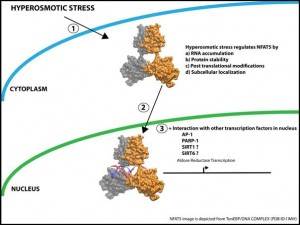
 SIRT interactions in hyperosmotic stress (click to enlarge)
At cellular level, hyperosmotic stress, as one of the mediators of diabetic vascular complications, regulates NFAT5 at 4 different levels: RNA accumulation, protein stability, post translational modifications and subcellular localization. (1) In particular, NFAT5 phosphorylation by p38, fyn, PKA and ATM have been shown to regulate both nuclear translocation and transcriptonal activator role of this factor. (2) Several other transcription factors such as AP-1 and PARP-1 have been also shown to be physicially associated with NFAT5 and their impact on NFAT5 dependent gene transcription have been previously presented. (3) With this background, we are currenly investigating the impact of SIRT1 and SIRT6 on NFAT5 dependent Aldose Reductase transcription.Â