COST Action EU-MACE MC meeting and Joint workshop (EERA – The European Energy Research Alliance & AMPEA & E3S)

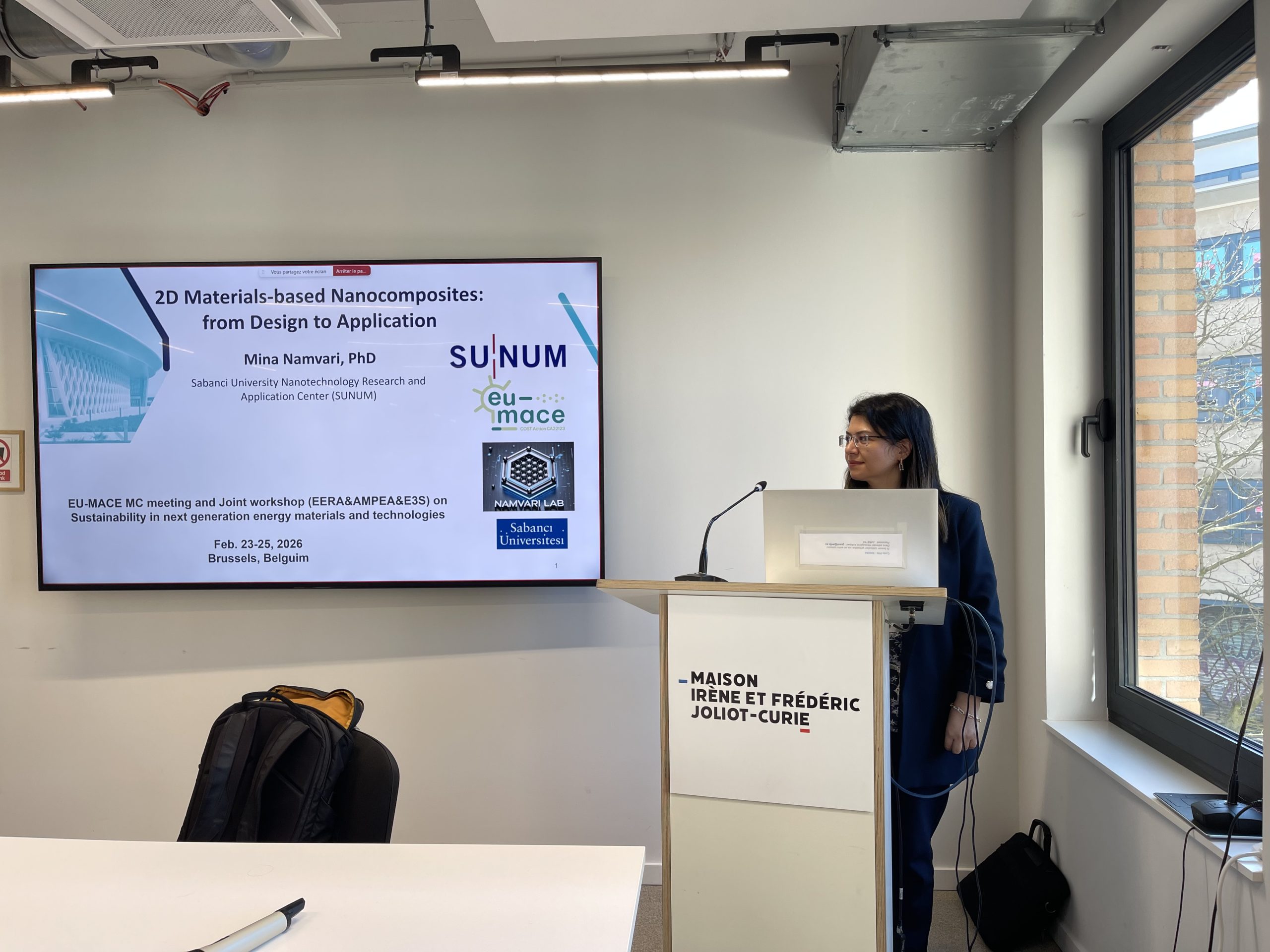
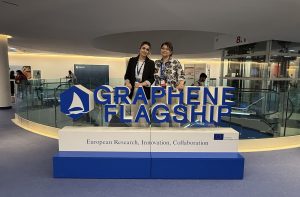
Dr. Namvari attended COST Action EU-MACE MC meeting and Joint workshop (EERA – The European Energy Research Alliance & AMPEA & E3S) on sustainability in next generation energy materials and technologies in Brussels 23-25 February. This evenet provided an environments to meet scientists with complementary competencies to stablish collaborations. We also gained information on EIC Pathfinder and Horizion Europe calls.
I would like to appreciate Dr. sawako nakamae for this kind invitation and Dorotea Koren for her assistance.

Publication in AdvancedMaterials Technologies

Happy to share our latest review article, entitled, “Electrochemical Etching: Towards a Scalable Production of MXene,” has been published in AdvancedMaterials Technologies (Wiley).
This article provides a concise overview of electrochemical etching of MXenes as a safer and more controllable alternative to conventional synthesis routes. It highlights the advantages of this approach in producing larger and more uniform MXene flakes with tunable surface terminations, and briefly discusses the key processing parameters governing material properties.

https://advanced.onlinelibrary.wiley.com/doi/full/10.1002/admt.202501403

Publication in CatChemCat

I am happy to share our recent publication in ChemCatChem in which 2D nano catalysts including graphene, reduced graphene oxide (rGO), MXene and exfoliated MXene (Exf. MXene) were synthesized and compared with commercial CNTs for use in all-vanadium redox flow batteries (VRFBs).

https://chemistry-europe.onlinelibrary.wiley.com/doi/full/10.1002/cctc.202501280

A huge thanks to the collaborators specifically Dr. Reza Afshar Ghotli and Dr. Barun Chakrabarti.

New Publication in Advanced Composites and Hybrid Materials (IF = 21.8) open access

New Publication in Advanced Composites and Hybrid Materials (IF = 21.8) open access
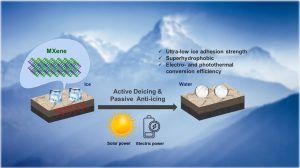
This is the first review in which the advancements in MXene-based anti-icing/deicing strategies are explored, categorizing them into photothermal, electrothermal, and hybrid mechanisms.
https://rdcu.be/eOlJw

MXene-based coatings have emerged as highly efficient materials for anti-icing and deicing applications, offering a combination of photo- and electrothermal properties. These coatings leverage high electrical conductivity, localized surface plasmon resonance (LSPR), and thermal stability of MXenes, particularly Ti3C2Tx, to achieve rapid ice melting and delayed freezing. Photo- and electrothermal coatings, which utilize solar energy and electric power, respectively, exhibit high efficiency.
in active deicing. Hybrid designs integrate superhydrophobicity, reducing heat transfer at the ice-coating interface and preventing secondary freezing. Functional modifications, such as hybridization with Ag nanowires, carbon nanotubes, graphene oxide, polydopamine, and polydimethylsiloxane, further enhance conductivity, mechanical stability, and oxidation resistance.
Invited talk at Graphene Flagship

Just wrapped up 5 enganing days at GrapheneWeek2025 in Vicenza!
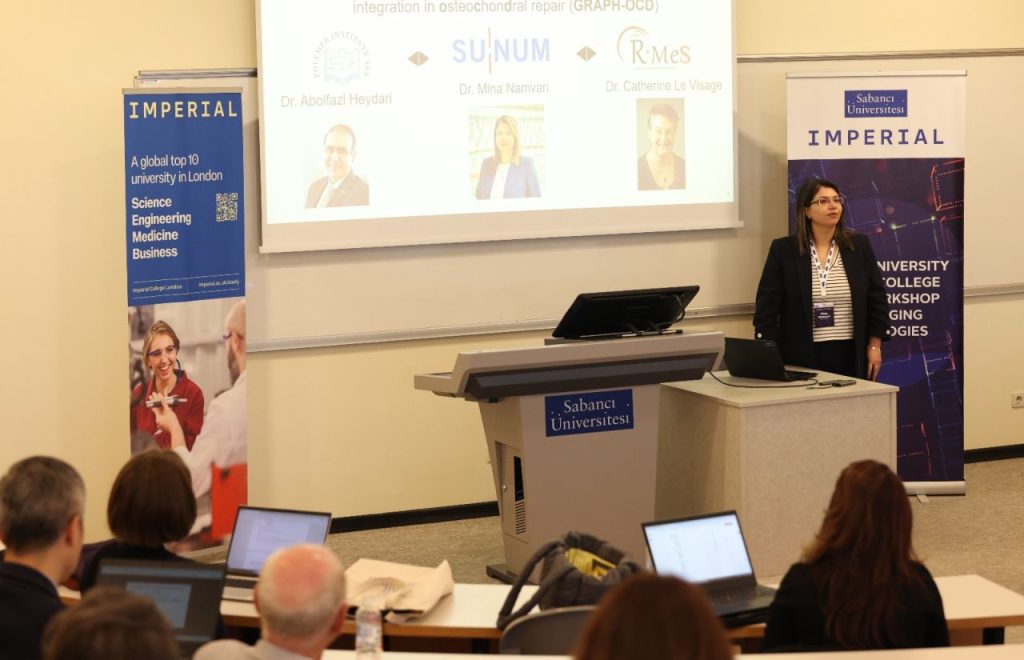
I had the pleasure of giving an invited talk disseminating our GRAPH-OCD project as a Partnering Project and Associated member at Graphene Flagship. Fereshteh Kazemi -Aghdam, represented our Slovakian partner at the conference.
I also talked about our recent article published in Biofabrication.
I would like to thank Dr. Stefania Vitale from The ESF – European Science Foundation for this kind invitation. My gartitude goes to the amazing conefernce chairs Prof. Aldo Di Carlo, Prof. Vincenzo Palermo, Prof. Camilla Coletti, and Dr. Francesco Bonaccorso.

I appreciate the funding agencies for the financial support FLAG-ERA, TÜBİTAK.

Publication in Small

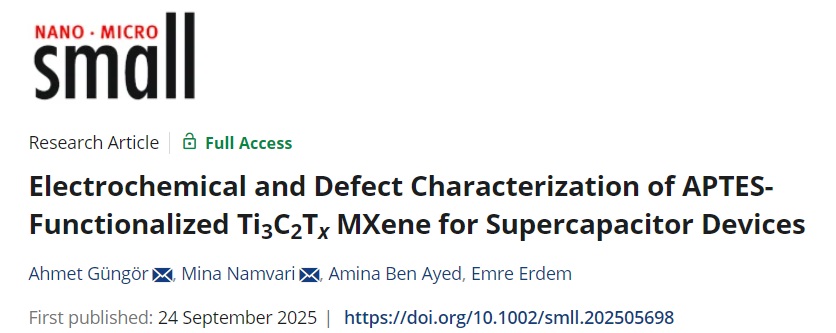
We just published an Invited article in in Small (IF = 12.1) https://onlinelibrary.wiley.com/doi/10.1002/smll.202505698
This work comprehensively investigates the structural, surface, and electrochemical properties of MAX phase,  MXene, and (3-aminopropyl) triethoxysilane-functionalized MXene (APTES-MXene) electrodes. The findings in the two-electrode system revealed that the APTES-MXene electrode exhibited a specific capacitance of 207.62 F g−1, an energy density of 28.83 Wh kg−1, and a capacity retention of 93.8%. The increased capacity and cycle stability obtained can be attributed to the multifaceted influence of APTES on surface chemistry and ion accessibility.

I would like to thank all the authors Dr. Ahmet Güngör, Prof. Emre Erdem, and Dr. Amina Ben Ayed for their great effort.
I would also like to express my gratitude to the funding agencies FLAG-ERA and TÜBİTAK for their support.
SUNUM-Sabancı University Nanotechnology Research and Application Center, Sabanci University

Presentation at IEEE International Conference on Nanomaterials: Applications and Properties (NAP) in Bratislava

I would like to thank Dr. Zeliha Cansu Canbek for presenting our collaborative work on MXene hydrogels at 15th IEEE International Conference on Nanomaterials: Applications and Properties (NAP) in Bratislava.

NanoTR19 in Ankara

We wrapped up an amazingly engaging 3-day event at OTDU. NanoTR19 was full of inspiring talks thanks to the great organizers. I enjoyed meeting Prof. Kourosh Kalantar-Zadeh and seeing Prof. Michael Naguib again and chating about MXene. We celebrated his birthday at the gala dinner.

My team presented 2 research studies: ‘3D network architecture of MXene and hashtaggraphene with antimicrobial properties’ as an oral presentation and ‘Antibacterial efficacy of Ti₃C₂Tx and Nb₂CTx MXenes against Gram-positive and Gram-negative bacterial strains’ as a poster. I would like to thank Dr. Amina Ben Ayed and Dr. Mina Masoudi for their effort.

It was also lovely seeing Dr. Ebru Soyuyüce Aydın at TUBITAK headquarters.

My appreciation goes to SUNUM-Sabancı University Nanotechnology Research and Application Center, FLAG-ERA, and TÜBİTAK for their financial support.