New Publication in Advanced Composites and Hybrid Materials (IF = 21.8) open access
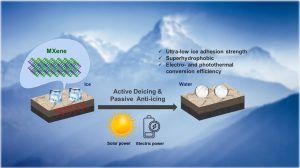
This is the first review in which the advancements in MXene-based anti-icing/deicing strategies are explored, categorizing them into photothermal, electrothermal, and hybrid mechanisms.
https://rdcu.be/eOlJw
MXene-based coatings have emerged as highly efficient materials for anti-icing and deicing applications, offering a combination of photo- and electrothermal properties. These coatings leverage high electrical conductivity, localized surface plasmon resonance (LSPR), and thermal stability of MXenes, particularly Ti3C2Tx, to achieve rapid ice melting and delayed freezing. Photo- and electrothermal coatings, which utilize solar energy and electric power, respectively, exhibit high efficiency.
in active deicing. Hybrid designs integrate superhydrophobicity, reducing heat transfer at the ice-coating interface and preventing secondary freezing. Functional modifications, such as hybridization with Ag nanowires, carbon nanotubes, graphene oxide, polydopamine, and polydimethylsiloxane, further enhance conductivity, mechanical stability, and oxidation resistance.