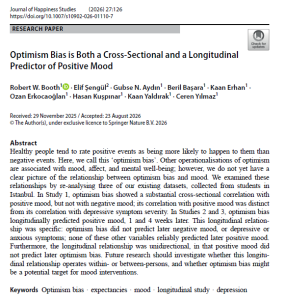
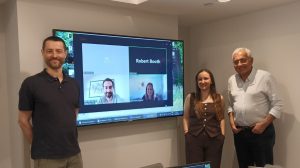
Dr Minel Güler joins the lab!
September 4th, 2026Warm welcome to Dr Minel Güler! Minel is joining us as a postdoctoral researcher, to work on my longitudinal studies about optimistic probability estimates and mood. Good to have you with us Minel!
Warm welcome to Dr Minel Güler! Minel is joining us as a postdoctoral researcher, to work on my longitudinal studies about optimistic probability estimates and mood. Good to have you with us Minel!
My student, newly-minted doctor Selen Gönül, has written a very good review of unconscious and preconscious threat processing in social anxiety. One main conclusion was that there isn’t enough research being done on this topic!
Well done, Selen!
Gönül, S., & Booth, R.W. Threat prioritisation under limited awareness in social anxiety: A review of masking and suppression paradigms. Cognition and Emotion. Advance online publication.
On Monday, my new TÜBİTAK-funded project officially began. It is called “Panel Studies of Optimism Bias and Positive Mood”, and it will run for the next two years.
My new postdoc and I will be running 6-wave longitudinal studies, to test whether within-person fluctuations in future expectancies predict later mood, depression, and anxiety. I look forward to posting our results here – watch this space!
It’s been a good week for my lab group 🙂 Yesterday, my master’s student Åžeyma Nur Kara successfully defended her thesis. Well done Åžeyma!

I am delighted to announce that my student Selen Gönül successfully defended her thesis on Friday! Congratulations Dr Gönül!

Last week, our new article “Psychometric properties of the Probability Bias Measure” was published in PloS One!
I have been studying probability bias for a few years now. For every project, we run into the problem that our test has not been validated. Well, now it has! This paper presents initial validation testing of the Probability Bias Measure in Turkish. The full Measure, in Turkish and English, is available here, and is free to use for research purposes.
The article is open access, i.e. freely available, from here.
My coauthors this time were the excellent Gubse Aydın, Beril Başara, and Ceren Yılmaz. They worked on the studies for their Independent Study Projects. Thank you team!
This week, a new paper of mine has been published online.
This is another collaboration with my friend Olesya Blazhenkova. She was interested in how placing a frame around an image affects our perception of it, and the various moderators of that effect. I helped with the analyses 🙂 This topic is a bit outside my usual research areas, but it’s an interesting paper and we’re very proud of it!
Blazhenkova, O., Dogerlioglu-Demir, K., & Booth, R. W. (2025). Rankings of Curved and Sharp-Angled Drawings: Frames and Evaluation Criteria. Art & Perception (published online ahead of print 2025). https://doi.org/10.1163/22134913-bja10070
If you’re interested in doing your Independent Study Project with me this semester, please get in touch NOW. I take ISP very seriously, and in recent years I’ve published a few papers with ISP students as co-authors.
You can propose your own project idea, or you can work on one of my ongoing projects, probably the vestibular stimulation project (the one called ‘My Head is Spinning!’ in Sona).
Tell me your GPA, and your grades for PSY202, PSY304, PSY305, and PSY306, if you’ve taken any of those yet.
Rob
Two weeks ago I spoke at the 4th Neuroscience, Law, Psychology, and Beyond symposium, which this time was hosted at Kadir Has University.
The theme of the symposium was ‘Neuotechnologies’, so I decided to rain on everyone’s parade, and give a talk called “Can ‘Mood Reading’, or Emotion-Recognition Technologies, Ever be Possible? A Counter-Argument”. This, I must admit, leaned heavily on Lisa Feldman Barrett and James Russell. In the spirit of starting an interesting discussion, I tried to make the point that engineering research on ’emotion-recognition’ technologies is usually several decades behind the current psychological theory, and is trying to do something that quite a lot of emotion theorists believe is logically impossible.
The event was filmed, hopefully I’ll be able to post the video here at some point …
Secondly, this paper was published in Emotion yesterday. This was actually my PROJ 201 project from Spring 2023; I came up with something a little different from what I normally do, and it turned out very well indeed! This was a pre-registered RCT of the Best Possible Self task, which is a popular intervention in the Positive Psychology literature. However, said literature was a little unclear as to whether this intervention improves positive mood, or increases optimism. We ran a large study, and it turned out the intervention does both of those things, and its effects on mood and optimism are largely independent. Intriguingly, we also found that the task improved our participants’ anxiety symptoms and one-week follow-up, which is quite a new finding, and I’m now running further trials to see if that effect is reliable.
My PROJ 201 students worked hard on preparing the materials for the study – we were the first to use the BPS task in Turkish – and they are all authors on the paper!
Booth, R. W., Erhan, K., Erkocaoğlan, O., Kuşpınar, H., & Yaldırak, K. (2024). The best possible self task has
direct effects on expectancies and mood, and an indirect effect on anxiety symptom severity. Emotion.
Advance online publication. https://doi.org/10.1037/emo0001481

Hi everyone, I’m back from my sabbatical. And I’m planning a cool little brain stimulation study! I need responsible, reliable people who can squirt (sterile) water into people’s ears, to see if it makes their heads spin. Yes, really!
So, if you’re interested in doing your Independent Study this semester, and that study sounds fun to you, please get in touch with me ASAP. Tell me your GPA, and your grades for PSY202, PSY304, PSY305, and PSY306, if you’ve taken any of those yet.
Rob
The first fruit of my sabbatical is published today: a set of studies I ran with my friend Dr Bundy Mackintosh, and Sabanci graduate Servet Hasşerbetçi. This one builds on the message from my last paper: probability bias is important 🙂 and has a direct, independent relationship with depressive symptoms, which cannot be explained by repetitive negative thinking.
Booth, R. W., Mackintosh, B., & Hasşerbetçi, S. (2024). Probability, cost, and interpretation biases’ relationships with depressive and anxious symptom severity: differential mediation by worry and repetitive negative thinking. Cognition and Emotion, advance online publication. https://doi.org/10.1080/02699931.2024.2348031
Hi, today I started a one-year sabbatical 🙂 So I will not be teaching any courses in the 2023-24 academic year.
This means PSY304 (Research Methods II), PSY311 (Emotion), and PSY411/511 (Cognition, Emotion and Psychopathology) will NOT open this year. PSY202 (Research Methods I) will open only ONCE, in Fall semester. Olesya has kindly offered to teach this course for me.
Don’t worry, I’ve not left; I will be back to my normal duties in Fall 2024. Academics just get research breaks like this every few years.
See you next year! x
On Saturday my new article was published in Motivation and Emotion 🙂 This one is called Probability bias is an independent correlate of depressive symptoms, and I ran the project with my colleague Çağla Aydın, and two excellent Independent Study Project students, Ekin Ulupunar and Mahnoor Nadeem.
You can find the paper here: https://doi.org/10.1007/s11031-023-10023-4
I’m rather late posting this, but in January another project of mine started, with TÜBİTAK support. Thanks, TÜBİTAK!
This one is called Türk Ögrencilerde Depresyon: Zamanlar Arası Bir Meta-Analiz (Depression in Turkish students: A cross-temporal meta-analysis), and I am running it in equal collaboration with my previous Master’s student, Elif Åžengül, with assistance from our friend İrem Ayçiçek.
We’re hoping to see whether reporting depressive symptom severity, among students at Turkish universities, has fluctuated since 1990. In particular, we are interested to see how depressive symptoms in this group were affected by the COVID-19 pandemic.
The project is progressing well, and I’m excited to see the results!
More good news: I was able to help my good friend Olesya Blazhenkova and our colleague Kıvılcım Döğerlioğlu Demir with one of their studies, about how face masks of different designs affect emotion recognition. This week the work has been published in the journal Cognitive Research: Principles and Implications. The article is freely available from the link below. I hope you like it!
Today another of my paper on probability estimates has been published. Whoo!
This one is, inevitably, about COVID. We show that, early on in the pandemic, Turkish people’s (self-reported) COVID-preventive behaviours were completely unrelated to their perceived risk of catching the virus, but were related to their overall probability estimates for positive events. In other words, people who made more optimistic estimates about the probabilities of their becoming wealthy, being successful, being liked by other people etc. were more likely to take effective action against COVID by staying home, wearing masks, and washing their hands. People who made more pessimistic estimates about their probability of catching COVID did not take action to protect themselves. Weird, right?
You can access the paper for free, until 23rd April, from here.
Booth, R.W., Peker, M., Yavuz, B.B., & Aksu, A. (2022). Estimated probabilities of positive, vs. negative, events show separable correlations with COVID-19 preventive behaviours. Personality and Individual Differences, 191, 111576. https://doi.org/10.1016/j.paid.2022.111576
Small announcement: I’m probably not going to take any Independent Study students this coming Fall semester, 2021. I really like running ISPs with good students, but this past semester I burned myself out trying to run four at once (plus a masters thesis or two), and I need to sit down and write some papers.
This really sucks, but I’ve learned that trying to help people out with ISPs, and then not being able to do them as well as I’d like, sucks even more.
A new article of mine has been published in the Journal of Behavior Therapy and Experimental Psychiatry! It’s called Biased probability estimates in trait anxiety and trait depression are unrelated to biased availability, and it reports a study I ran in England a couple of years ago with my old friend Dinkar Sharma. You can access a preprint via the link below (or by emailing me and asking for one!).
This is now the second article I’ve published on judgement biases in anxiety and depression, which has become my main research interest over the last few years. I have a whole bunch of very interesting datasets sitting on my desktop, so hopefully you’ll see a few more articles about this from me before the end of the year!Â
Booth, R.W., & Sharma, D. (2021). Biased probability estimates in trait anxiety and trait depression are unrelated to biased availability. Journal of Behavior Therapy and Experimental Psychiatry, article in press.
On 7th-8th October, my friends at MEF University held a great symposium on different approaches to free will. I took the opportunity to talk about judgement biases, and how they might introduce predictable biases in the ‘free’ decisions of healthy and not-so-healthy people. You can watch the video here:
Free will talk (Turkish dubbed)
(This is the Turkish-dubbed version, because the talk was broadcast with a simultaneous translation. If we can find the original English version, I will post that too.)